

Let’s be honest. Running a marketing team in Australia or New Zealand right now is a bit much. Budgets are tight, customer expectations have moved on, competitors are louder, and every second week there’s a new AI tool everyone says you have to be using by Friday.
Good news: most of them you don’t. The handful that genuinely earn their keep tend to fall into four categories, and once you know which category solves which problem, the rest is a lot less noisy.
This guide walks through the AI marketing tools that are actually pulling weight for ANZ teams in 2026, what each category is for, and what to ask before you buy anything.
The four categories of AI marketing tools (and what each one’s really for)
Before the tool list, the categories. Most of the confusion in this space comes from comparing tools that aren’t trying to do the same job.
- Generative AI for content: writes, drafts, edits. ChatGPT, Claude, Gemini, Jasper, Canva AI. Best for copy production speed, content variations, brainstorming.
- AI-powered analytics: spots patterns, predicts behaviour. GA4 with predictive metrics, Looker with Gemini, Wondaris. Best for turning your existing data into next actions.
- AI marketing automation: orchestrates journeys and lifecycle comms. HubSpot Breeze, Salesforce Einstein, Braze. Best for nurture, retention, lifecycle.
- AI-assisted advertising: bids, audiences, creative optimisation inside the ad platform. Google Performance Max, Meta Advantage+, AdCreative.ai. Best for paid media efficiency at scale.
The mistake most teams make is buying a tool from one category to solve a problem in another. A generative AI tool won’t fix attribution. An automation platform won’t write better ad copy. Pick the category that matches the bottleneck.
Why this matters more in ANZ specifically
A few things are happening at once for Australian and NZ marketing teams that make AI adoption less optional than it was a year ago.
The AI market in Australia is growing about 15% a year through 2026. Cheaper tooling, more local case studies, and easier integrations mean the early-adopter premium is gone. If you wait another year, you’re not getting in early. You’re catching up.
Social commerce is now a real channel. Roughly 42% of Australians buy directly through social platforms every month. TikTok Shop’s full ANZ rollout has pushed this further. Manually managing personalised social campaigns at that volume isn’t really a job a human can do well anymore.
Content fatigue is real. Around 58% of marketers report creative burnout. AI tools that take the first 70% of a content draft off your plate are the difference between shipping weekly and shipping monthly.
Privacy rules keep moving. The Privacy Act changes, third-party cookie deprecation in the rest of the Google ecosystem, and the NZ Privacy Act updates all push more weight onto first-party data. AI tools that can predict and personalise from first-party signals are worth more than they were 18 months ago.
Best AI marketing tools for ANZ teams in 2026
1. Content creation and management
Still a strong choice if your problem is content volume. Blog drafts, social variations, ad copy in tone. Australian-flavoured outputs got noticeably better through 2025. A Brisbane retailer we work with said engagement on their organic social roughly doubled after standardising drafts through Jasper, mostly because they could finally test 8 variations a week instead of 2.
Australian-built, and the AI features have got serious. Magic Design, Magic Write and the brand-kit-aware image gen do most of what mid-market design teams need for social and ad creative. If your team is small and you’re not paying a designer for every post, Canva AI is hard to beat.
The general-purpose models matter more than the marketing-specific wrappers built on top of them. Claude is the stronger writer for long-form, ChatGPT is faster for iteration and has the bigger plugin ecosystem. Most marketing teams end up using both. Worth having proper team accounts rather than personal logins, both for security and for the better usage limits.
2. Customer data, analytics and audience activation
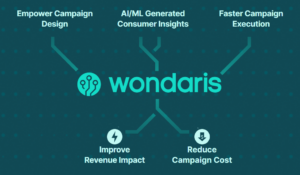
Wondaris pulls your customer data into one place and adds pre-built predictive models on top: predicted lifetime value, likelihood to buy, churn risk. From there you can build audiences and push them straight into your ad platforms without a data team running a query every time. The faster bit is the activation. The smarter bit is the prediction layer doing the segmentation for you.
If you’re already on GA4 (and you should be), the predictive audiences (likely 7-day purchasers, predicted revenue, churn probability) are free and underused. Most ANZ teams haven’t turned them on. They feed straight into Google Ads as audiences. Quick win if you’ve got enough conversion volume to qualify.
Gemini in Looker means you can ask your dashboards questions in plain English instead of writing LookML. For marketing teams without dedicated BI support, this changes how often you actually look at your numbers. Worth it once your data lives in BigQuery.
Social listening that handles ANZ slang and tone properly. Useful for brand monitoring, competitor tracking, and surfacing where your customers actually talk about your category.
3. Ad campaign optimisation
Google Performance Max and Meta Advantage+
The AI-driven campaign types from the platforms themselves are where most ANZ advertisers should start. They’re free, they’re integrated, and the model quality keeps improving. The trick is giving them the right inputs (clean conversion signals, creative variety, audience signals) rather than treating them as a black box. XPON’s Google Marketing Platform team handles a lot of this kind of setup for retail and finance clients.
Generates ad creative variations and predicts which ones will perform before you spend on them. An Adelaide e-commerce client reported a 50% lift in conversion rate after switching to AdCreative.ai outputs for their Meta creative. Worth piloting if you’re running paid social at any scale.
Autonomous campaign management across channels. Sits on top of your ad platforms and reallocates spend based on performance. Heavier setup, but valuable if you’re running omnichannel paid media with limited team capacity.
4. Marketing automation and lifecycle
HubSpot’s AI layer is now baked into the platform. Breeze Intelligence enriches contacts automatically, Content Agent drafts emails and landing page copy in your brand voice, and the predictive lead scoring is materially better than it was. If you’re already on HubSpot, Breeze is a setting to turn on, not a new tool to learn.
For enterprise teams already on Salesforce. Einstein handles predictive scoring, send-time optimisation, and journey personalisation across the Marketing Cloud stack. Powerful but assumes you’ve got a properly maintained Salesforce setup behind it.
5. Enterprise custom AI
If you need custom models (fraud detection, demand forecasting, content personalisation at scale) rather than off-the-shelf tooling, Vertex AI is the platform. ANZ enterprises use it for tailored use cases inside the Google Cloud ecosystem. Heavier lift, longer payback. Right answer for the right problem.
How to choose between them without buying the wrong thing
The five questions worth answering before any purchase decision.
- What’s the actual bottleneck? Pick from the four categories above. If you can’t name the bottleneck, you’re not ready to buy a tool yet.
- Will it integrate with what you’ve already got? An AI tool that doesn’t talk to your CRM, your ad platforms or your analytics is going to drive a tab-juggling habit and not much else.
- Who’s actually going to use it? The tool with the best demo is rarely the one your team will pick up. Test for daily-use friction, not feature coverage.
- Is it built or trained for ANZ? Currency, spelling, slang, privacy compliance and platform integrations matter more than they look in a US-shot demo video.
- How will you measure whether it worked? Define the metric before you sign. “Saved time” isn’t measurable. “Cut content production time per blog from 6 hours to 2” is.
What’s coming next for AI marketing in ANZ
Three things worth watching through 2026.
Generative search is changing where your audience finds you. ChatGPT, Claude, Perplexity and Google’s AI Overviews are pulling traffic that used to come through traditional search. Optimising your content to be cited by these systems (sometimes called GEO, generative engine optimisation) is becoming a real workstream. Server-side measurement matters more here because you’re losing the click-through visibility you used to have.
First-party data keeps getting more valuable. Every AI personalisation tool only works as well as the data it’s fed. Teams with proper customer data foundations will run circles around teams without them, regardless of which AI tool they pick.
The “AI for marketing” category is going to get less distinct. Most of the tools you already use will have AI baked in within the next 12 months. The question shifts from “which AI tool should I buy” to “which features should I turn on in the tools I’ve already got”.
FAQ
What are the best AI marketing tools for Australian and NZ businesses in 2026?
It depends what you’re solving for. For content production, Jasper, Canva AI and Claude. For customer data and audience activation, Wondaris and GA4 predictive audiences. For ads, Google Performance Max, Meta Advantage+ and AdCreative.ai. For marketing automation, HubSpot Breeze or Salesforce Einstein depending on what you’re already running. Start by naming the bottleneck, then pick from the right category.
What’s the difference between generative AI tools and AI marketing automation platforms?
Generative AI tools (ChatGPT, Claude, Jasper, Canva AI) create content. Marketing automation platforms (HubSpot, Salesforce, Braze) orchestrate when and how that content is delivered. You usually need both, but they solve different problems. Buying an automation platform won’t help if your problem is producing enough content. Buying a content tool won’t help if your problem is lifecycle nurture.
How much do AI marketing tools cost for a mid-sized ANZ business?
Wide range. Content tools like Jasper and Canva Pro AI sit at $20-50 per user per month. Marketing automation platforms with AI features (HubSpot Breeze, Salesforce Einstein) start around $800-2,000 per month for mid-market plans. Customer data platforms like Wondaris are typically project-priced based on data volume and integration scope. Vertex AI and other custom builds are usage-based and can run from a few hundred to tens of thousands per month depending on workload. Most teams find the content layer pays for itself fastest.
Which AI marketing tools integrate with Google Marketing Platform?
Most do. GA4, Looker with Gemini, and Google Cloud Vertex AI integrate natively. Wondaris, HubSpot and most major martech platforms integrate via APIs or pre-built connectors. The richer integrations are usually with Google’s own stack (Performance Max audiences, GA4 audiences exported to Google Ads, Looker dashboards in Google Cloud). Our full GMP guide covers the integration map in more detail.
Are AI marketing tools worth it for small businesses in Sydney, Melbourne or Brisbane?
Yes, but pick carefully. Canva AI, ChatGPT Team plans, and HubSpot’s free tier with Breeze are the highest-leverage starting points for small teams. Skip the enterprise platforms until you’ve got the data volume and team size to justify them. The biggest wins for small ANZ businesses are usually in content production (Canva, Jasper, ChatGPT) and ad creative (AdCreative.ai), where AI takes hours of work down to minutes without needing a data engineer to set it up.
Where to start
If you’re trying to work out which of these to actually use, the honest answer is that the tools matter less than the foundations. Clean first-party data, clear measurement, and a team that knows what problem they’re trying to solve will get more out of a basic toolset than a confused team with the best stack money can buy.
If you want a second opinion on where your business sits and where the highest-leverage AI investment would be, our AI Readiness Assessment benchmarks your current capabilities and maps a phased approach to adoption. It takes about 15 minutes, you get a report at the end, and there’s no obligation to do anything with it.